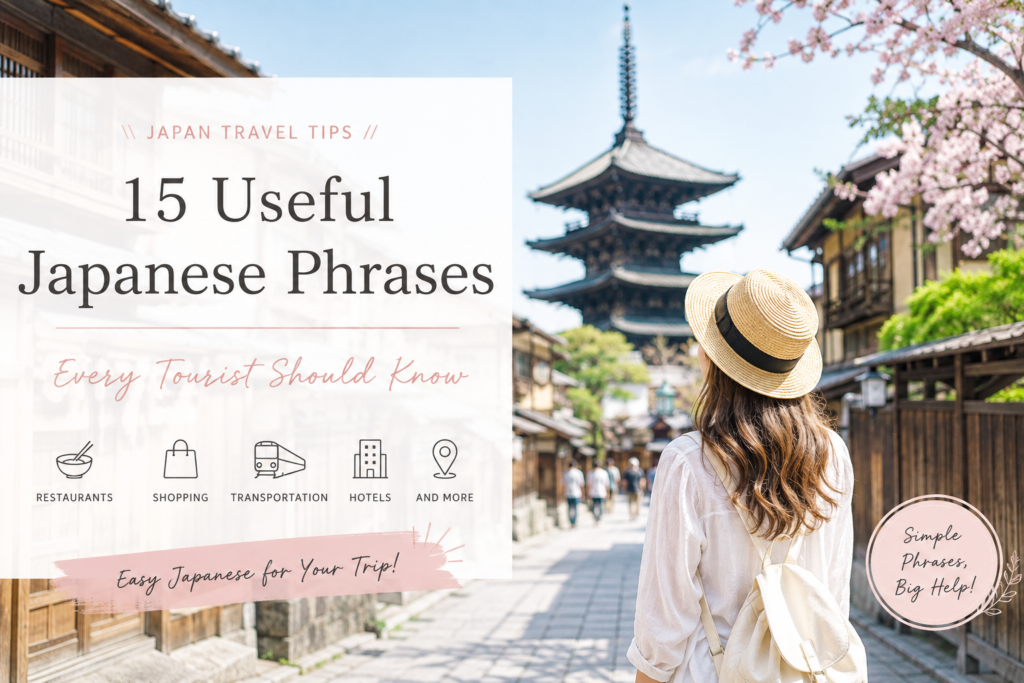
Traveling to Japan is an exciting experience. From exploring Tokyo and Kyoto to enjoying local food and discovering hidden neighborhoods, there is so much to experience.
But there is one thing that may surprise first-time visitors:
English is not always widely spoken in Japan.
You can usually find English signs and English-speaking staff at major airports, hotels, and tourist attractions. However, once you visit a small local restaurant, shop, or rural area, communicating in English may be more difficult.
The good news?
You don’t need to speak fluent Japanese.
Learning just a few simple Japanese phrases can make your trip easier—and may even help you have more friendly interactions with local people.
Here are some useful Japanese phrases worth remembering before your trip.
Is English Spoken in Japan?
Japan is a very tourist-friendly country, and English is available in many popular tourist areas.
Major hotels, airports, train stations, and attractions often have English signs and information.
However, English may not always be understood at smaller local businesses.
You may encounter situations where English is limited at:
- Small local restaurants
- Local shops
- Traditional Japanese restaurants
- Small train stations
- Local buses
- Taxi rides
- Rural tourist attractions
- Neighborhood stores
This doesn’t mean you will have a difficult time traveling.
Translation apps, maps, and visual communication can help a lot.
But knowing a few Japanese phrases gives you one more useful way to communicate.
Why Is It Useful to Speak Japanese in Japan?
You don’t need to memorize hundreds of Japanese words.
Even knowing five or ten phrases can be surprisingly helpful.
It Makes Everyday Situations Easier
For example, imagine visiting a small restaurant with a menu written only in Japanese.
You can simply point at a dish and say:
これください。
Kore kudasai.
This one, please.
That’s it.
You don’t need to know how to read the entire menu.
Locals Appreciate the Effort
Even if your Japanese isn’t perfect, making an effort is often appreciated.
Saying:
ありがとうございます。
Arigatou gozaimasu.
Thank you very much.
after someone helps you is a simple way to show politeness.
It Can Help When English Doesn’t Work
Translation apps are extremely useful, but they aren’t perfect for every situation.
Your phone may not have an internet connection, the conversation may be too quick, or you may simply want to ask a quick question.
Knowing a few basic phrases can make those moments much easier.
15 Useful Japanese Phrases for Tourists
You don’t need to memorize all of these.
Start with the phrases that are most relevant to your trip.
1. Hello — こんにちは
こんにちは
Konnichiwa
Hello / Good afternoon
One of the easiest Japanese words to remember.
You can use it when meeting someone or starting a conversation during the daytime.
2. Thank You — ありがとうございます
ありがとうございます
Arigatou gozaimasu
Thank you very much
This is one of the most useful Japanese expressions for travelers.
You’ll have many opportunities to use it during your trip.
For example, say it when a hotel employee helps you, a restaurant serves your food, or someone gives you directions.
3. Excuse Me — すみません
すみません
Sumimasen
Excuse me / Sorry
This is one of the most useful words in Japanese because it can be used in several situations.
For example:
すみません、駅はどこですか?
Sumimasen, eki wa doko desu ka?
Excuse me, where is the station?
You can also use すみません to apologize or get someone’s attention.
4. This One, Please — これください
これください
Kore kudasai
This one, please
This phrase is especially useful for shopping and ordering food.
Simply point at something and say:
これください。
You can use it at restaurants, convenience stores, souvenir shops, markets, and cafés.
5. How Much Is It? — いくらですか?
いくらですか?
Ikura desu ka?
How much is it?
If you don’t see the price of an item, ask:
これはいくらですか?
Kore wa ikura desu ka?
How much is this?
A very useful phrase for shopping in Japan.
6. Where Is It? — どこですか?
どこですか?
Doko desu ka?
Where is it?
This simple phrase can be combined with different words.
For example:
トイレはどこですか?
Toire wa doko desu ka?
Where is the restroom?
ホテルはどこですか?
Hoteru wa doko desu ka?
Where is the hotel?
駅はどこですか?
Eki wa doko desu ka?
Where is the station?
Useful Japanese for Restaurants
Japanese food is one of the biggest reasons people visit Japan.
From sushi and ramen to yakitori and regional specialties, you’ll probably eat at many different types of restaurants during your trip.
These phrases can help.
Do You Have an English Menu?
英語のメニューはありますか?
Eigo no menyuu wa arimasu ka?
Do you have an English menu?
This can be especially useful at small local restaurants.
One of These, Please
これを一つください。
Kore o hitotsu kudasai.
One of these, please.
You can point at something on the menu or display case.
Water, Please
お水ください。
Omizu kudasai.
Water, please.
A simple phrase that can come in handy at restaurants.
The Bill, Please
お会計お願いします。
O-kaikei onegai shimasu.
The bill, please.
In many Japanese restaurants, you pay at the register rather than at the table, so after saying this, you may simply be directed to the cashier.
It Was Delicious
おいしかったです。
Oishikatta desu.
It was delicious.
This is a great phrase to remember.
After enjoying a meal at a local restaurant, saying おいしかったです to the staff is a simple and friendly way to express your appreciation.
Useful Japanese for Shopping
Japan has everything from convenience stores and department stores to local markets and unique souvenir shops.
These phrases can help when shopping.
Do You Have Another Size?
他のサイズはありますか?
Hoka no saizu wa arimasu ka?
Do you have another size?
Useful when shopping for clothes or shoes.
Can I Try This On?
試着できますか?
Shichaku dekimasu ka?
Can I try this on?
Useful at clothing stores.
Can I Use a Credit Card?
クレジットカードは使えますか?
Kurejitto kaado wa tsukaemasu ka?
Can I use a credit card?
Although credit cards and other cashless payment methods are widely accepted in Japan, you may still encounter smaller businesses that prefer or require cash.
I Don’t Need a Bag
袋はいりません。
Fukuro wa irimasen.
I don’t need a bag.
This can be useful at convenience stores and shops.
Useful Japanese at Hotels
Staff at major international hotels often speak English, but knowing a few Japanese phrases can still be useful.
I Have a Reservation
予約しています。
Yoyaku shiteimasu.
I have a reservation.
You can then show your booking confirmation on your phone.
What Time Is Breakfast?
朝食は何時ですか?
Choushoku wa nanji desu ka?
What time is breakfast?
A useful phrase when checking into a hotel.
Where Is the Elevator?
エレベーターはどこですか?
Erebeetaa wa doko desu ka?
Where is the elevator?
Simple but useful, especially in large hotels.
Useful Japanese for Trains and Transportation
Japan’s railway system is famous for being convenient, but it can sometimes feel complicated for first-time visitors.
A few simple phrases can help if you get confused.
Does This Train Go to Tokyo?
この電車は東京に行きますか?
Kono densha wa Tokyo ni ikimasu ka?
Does this train go to Tokyo?
You can replace 東京 (Tokyo) with another destination.
For example:
この電車は京都に行きますか?
Kono densha wa Kyoto ni ikimasu ka?
Does this train go to Kyoto?
Where Is the Station?
駅はどこですか?
Eki wa doko desu ka?
Where is the station?
Where Can I Get a Taxi?
タクシーはどこですか?
Takushii wa doko desu ka?
Where can I get a taxi?
Useful Japanese for Emergencies
Hopefully, you won’t need these phrases, but they’re worth knowing.
Help Me
助けてください。
Tasukete kudasai.
Please help me.
I Don’t Understand
わかりません。
Wakarimasen.
I don’t understand.
This can be particularly useful when you are having difficulty communicating.
You can also say:
英語は話せますか?
Eigo wa hanasemasu ka?
Do you speak English?
Japanese Words You Will Hear Everywhere
There are a few Japanese expressions you will probably hear constantly during your trip.
You don’t necessarily need to use them yourself, but understanding them can make your experience easier.
いらっしゃいませ — Irasshaimase
Meaning: Welcome!
You’ll hear this when entering restaurants, convenience stores, supermarkets, and many other shops.
Don’t worry—you don’t need to reply.
A smile or small nod is perfectly fine.
いただきます — Itadakimasu
Meaning: A phrase traditionally said before eating
Japanese people often say いただきます before starting a meal.
It expresses appreciation for the food and the people involved in preparing it.
You can try saying it before your meals during your trip.
ごちそうさまでした — Gochisousama deshita
Meaning: Thank you for the meal
This is commonly said after finishing a meal.
If you eat at a small local restaurant, saying ごちそうさまでした when leaving is a nice way to show appreciation.
5 Japanese Phrases You Should Memorize
If remembering 15 or 20 phrases feels like too much, start with these five:
| Japanese | Romaji | Meaning |
|---|---|---|
| こんにちは | Konnichiwa | Hello |
| すみません | Sumimasen | Excuse me |
| ありがとうございます | Arigatou gozaimasu | Thank you |
| これください | Kore kudasai | This one, please |
| いくらですか? | Ikura desu ka? | How much is it? |
These five phrases can already help you in many everyday situations.
You Don’t Need Perfect Japanese
One of the biggest mistakes travelers make is thinking they need to speak Japanese perfectly before visiting Japan.
You don’t.
Even a few simple words can be enough.
If you walk into a restaurant and say:
こんにちは。
Then point at a dish and say:
これください。
And finish your meal with:
ごちそうさまでした。
You’ve already had a perfectly good interaction in Japanese.
Don’t worry if your pronunciation isn’t perfect. Most Japanese people will understand what you’re trying to say from the context.
And if communication becomes difficult, you can always use a translation app or simply show the information on your phone.
A Little Japanese Can Make Your Japan Trip More Memorable
Traveling in Japan without speaking Japanese is absolutely possible.
But learning a few basic phrases can make your trip more comfortable, especially when visiting smaller local businesses or places outside major tourist destinations.
More importantly, using Japanese gives you an opportunity to interact with Japan in a slightly different way.
A simple:
「ありがとうございます」
can make a small interaction feel warmer.
So before your trip, don’t try to memorize an entire Japanese textbook.
Just learn a few phrases, practice saying them out loud, and use them when you get to Japan.
You might be surprised by how far a little Japanese can take you.
Aichi Airport Alcoholic beverage Anime Anime pilgrimage April Architecture August Autumn Building Capital Area Cherry blossom Convenience store February Flower January Japanese food kanto Kinki Kyoto March May Nagoya Nature Nightlife Night view Osaka Photogenic Pink Sakura Shopping Shrine Souvenir Spring Station Summer Superb view Temple Tips Tokai Tokyo Traffic train White Winter

More from my site
 Attention Travelers! Japan’s Tax-Free System is Changing: What You Need to Know in 2026
 Is Japan Still Cheap? 2026 Price Comparison for Travelers
 How to Use Japanese Toilets: Washlet, Bidet & Buttons Explained
 Cash or Card in Japan: A Complete Guide for Visitors
 Japan’s Power Outlets: What Travelers Need to Know
 The Complete Guide to Flying Domestic in Japan: Rules, Security & Tips