
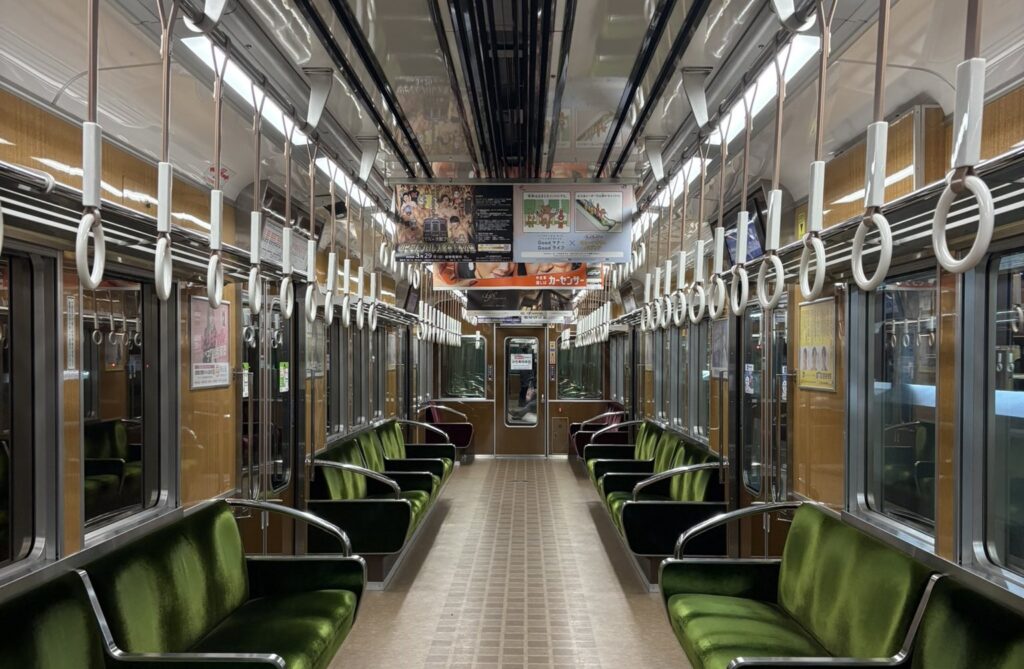
Here is the complete, ready-to-publish article for international tourists. It balances helpful advice with a serious warning about social media risks.
Silence is Golden: A Guide to Train Etiquette in Japan
Japan’s train system is legendary—not just for being on time, but for being incredibly quiet. For many travelers, the silence in a packed Tokyo subway car can be surreal. While you might be used to chatting on your phone back home, doing so in Japan is one of the fastest ways to cause friction.
Here is everything you need to know to travel like a pro and avoid unnecessary trouble.
1. Is it Illegal to Talk on the Phone?
The short answer is no. There is no law that will lead to an arrest or a fine for taking a call.
However, in Japan, social manners (Mana-) carry as much weight as laws. Every train car has signs and announcements explicitly asking passengers to set their phones to “manner mode” (silent) and refrain from talking. Following these rules is seen as a basic sign of respect for those around you.
2. Why the “Cold Stares”?
If you start a conversation on your phone, you will likely notice fellow passengers giving you “the look.” In Japanese culture, the train is a shared public space where everyone is entitled to peace.
- Reading the Air (Kuuki wo yomu): This is the Japanese concept of sensing the social atmosphere. When 100 people are sitting in silence, one person talking on a phone “breaks the air” and is seen as selfishly prioritizing their own business over the group’s comfort.
3. ⚠️ The Modern Risk: Social Media Shaming
In the past, the worst consequence was a dirty look or a polite scolding from a train conductor. Today, the stakes are higher.
Be aware that some locals may secretly film or photograph people breaking etiquette. * SNS Shaming: Photos of “rude tourists” are occasionally uploaded to platforms like X (Twitter) or TikTok.
- Privacy Issues: Being the subject of a viral video for “bad manners” can ruin your trip and is a stressful situation to navigate in a foreign country.
- The Bottom Line: To protect your own privacy and reputation, it is best to simply keep your phone in your pocket.
4. How to Handle Your Phone Like a Local
| Situation | What to Do |
| Incoming Call | Immediately silence the ringer. Do not answer. |
| Emergency Call | If you must answer, whisper “I’ll call you back,” and hang up within seconds. |
| Shinkansen | You can talk, but only in the deck areas between the cars. Never at your seat. |
| Texting/Games | Perfectly fine, but ensure your sound is off and you aren’t bumping into others. |
5. The “Priority Seat” Rule
At the ends of most train cars, you will see Priority Seats (for the elderly, pregnant, or disabled). In these areas, signs often ask you to turn off your phone entirely during rush hour. This is a gesture of respect for passengers who may have medical devices like pacemakers. Even if the car isn’t crowded, avoid using your phone at all when standing near these seats.
Conclusion: Respect the Ride
Japanese trains are more than just transportation; they are a sanctuary of quiet for commuters. By keeping your phone on silent and saving your calls for the station platform, you aren’t just avoiding “cold stares”—you are showing deep respect for Japanese culture.
Enjoy the peaceful commute, and welcome to Japan!
More from my site
 Japan Travel Planning Made Simple: Times from Tokyo & Osaka
 Safe Travel in Japan: Understanding Train and Bus Security
 The Ultimate Guide to Riding Trains in Japan
 How to Get from Chubu Centrair Airport to Nagoya City Center
 More Than Transportation: How to Enjoy Japan’s Shinkansen Like a Local
 How to Get from Kansai International Airport (KIX) to Osaka, Kyoto, and Nara