
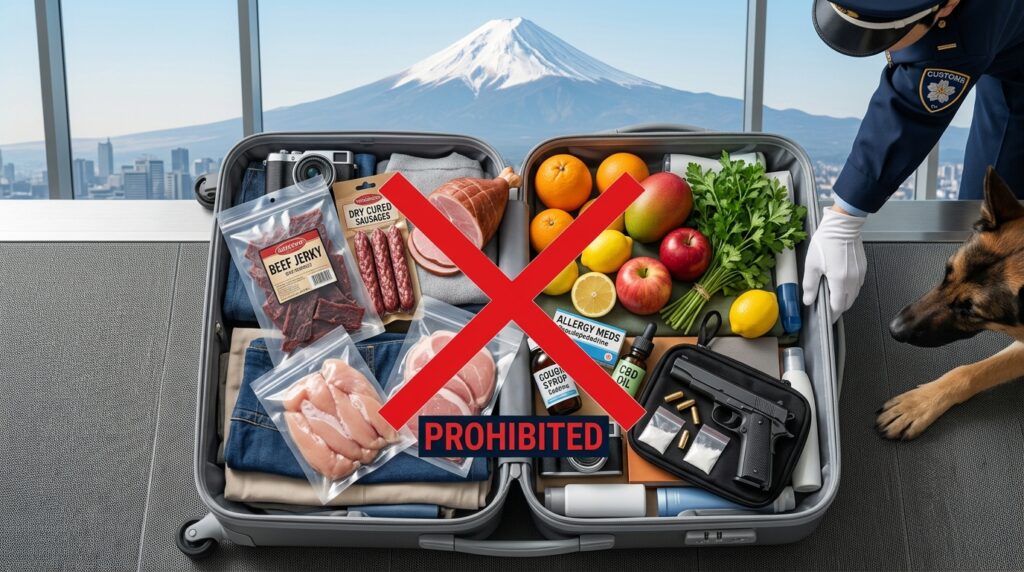
What Cannot Be Brought into Japan? Forbidden & Restricted Items Guide (2026 Updated)
When traveling to Japan, one of the most critical steps before packing your luggage is checking the country’s strict customs, animal quarantine, and plant protection regulations. Many tourists inadvertently bring forbidden items—such as meat products, fresh fruits, or specific over-the-counter medications—resulting in severe fines, major travel delays, or legal penalties at airport customs.
This complete guide outlines what is strictly prohibited, what is restricted, the exact consequences of non-compliance, and common mistakes foreign visitors make when entering Japan.
Quick Reference: Most Common Airport Confiscations
If you are in a hurry, here are the top items that tourists most frequently get stopped for at Japanese customs:
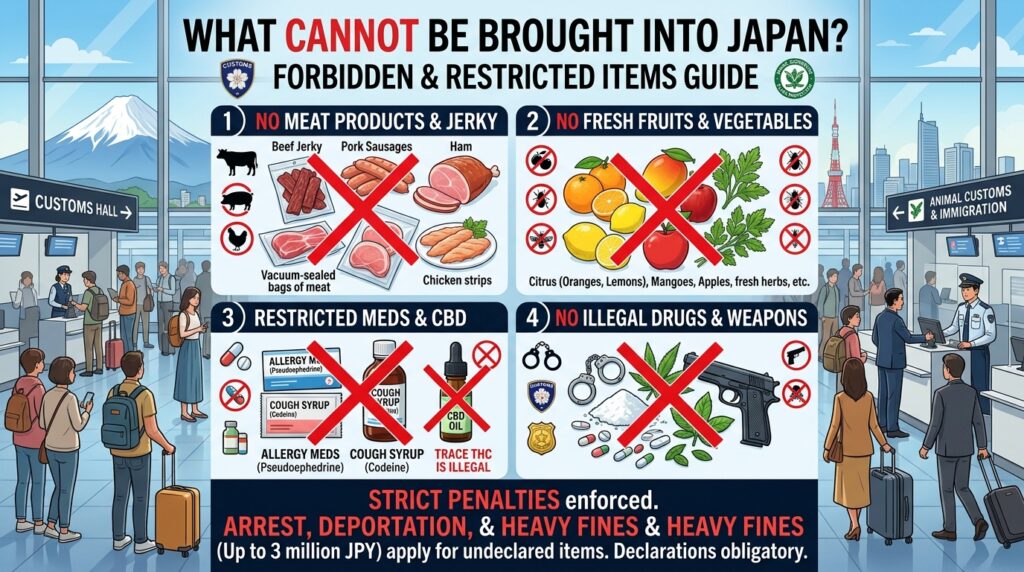
- All Meat Products & Jerky: Pork, beef, chicken, ham, sausage, and jerky (even vacuum-sealed or duty-free shop purchases).
- Fresh Fruits & Vegetables: Citrus fruits, mangoes, apples, and fresh herbs from most countries.
- Over-the-Counter Medications: Allergy or cold medicines containing Pseudoephedrine, Codeine, or CBD products with detectable THC.
- E-Cigarettes & Nicotine E-Liquids: Nicotine-containing e-liquids are regulated as medicinal products in Japan.
- Counterfeit Goods: Fake brand bags, watches, or imitation apparel.
1. Absolute Prohibitions (Illegal & Strictly Banned)
Bringing any of the following items into Japan is illegal under Japanese law and will result in immediate confiscation, heavy fines, deportation, or arrest.
- Illegal Drugs & Controlled Substances: Cannabis/Marijuana (including CBD products containing trace THC), Heroin, Cocaine, MDMA, Methamphetamines, and Opioids.
- Firearms, Weapons, & Ammunition: Guns, handguns, rifles, bullets, and weapon parts (including functional replica firearms).
- Explosives & Chemical Weapons: Fireworks, gunpowder, and toxic chemical substances.
- Counterfeit & Pirated Goods: Fake designer goods (bags, watches, clothes) that infringe on intellectual property rights.
- Obscene Materials: Uncensored adult media, child pornography, or materials violating public morality.
2. Animal Products & Meat (The #1 Quarantine Trap)
Japan maintains strict biosecurity to prevent African Swine Fever (ASF) and Avian Influenza. Animal quarantine rules are enforced vigorously at all entry points.
Prohibited Meat Items:
- All types of meat: Beef, pork, chicken, duck, lamb, and goat.
- Processed meat products: Beef jerky, ham, bacon, sausages, and meat pies.
- Pre-packaged & Vacuum-sealed items: Even if purchased at airport duty-free shops or clearly sealed in commercial packaging.
- Ramen with meat extract: Instant noodles containing actual meat bits or concentrated meat extracts may be confiscated depending on the origin country.
Important Note: You cannot bring meat products into Japan simply by declaring them unless they are accompanied by an official inspection certificate issued by the government agency of the exporting country (which is virtually impossible for standard retail tourists to obtain).
3. Plant Products, Fruits & Vegetables
To protect Japanese agriculture from invasive pests such as the Mediterranean fruit fly and oriental fruit fly, many fresh items are banned or require strict inspection.
Strictly Prohibited Fresh Produce (Varies by Origin):
- Citrus fruits: Oranges, lemons, and limes from many western regions.
- Tropical fruits: Mangoes, papayas, and mangosteens from Southeast Asia.
- Apples, pears, and peaches: Fresh stone fruits from various countries.
- Soil & Plants with Soil: Any live plant potted in soil is banned.
Allowed Only After Quarantine Inspection:
- Dried fruits (processed and commercialized without seeds/soil).
- Cut flowers and polished rice (subject to physical inspection at the Plant Quarantine counter prior to immigration).
4. Medication, Cosmetics & CBD Rules
Japan has extremely strict pharmaceutical laws under the Pharmaceutical and Medical Devices Act. Items sold over-the-counter in Western countries or other parts of Asia may be illegal controlled substances in Japan.
Banned OTC Medications:
- Pseudoephedrine: Commonly found in sinus and allergy medication (e.g., Sudafed, Claritin-D). Any product containing more than 10% pseudoephedrine is prohibited.
- Codeine: Present in over-the-counter painkillers and cough syrups in some countries.
- CBD Products: CBD oil, gummies, or vape cartridges containing any detectable trace of THC are classified as illegal cannabis under Japanese law.
Quantity Limits for Personal Use:
- Prescription Drugs: Up to a 1-month supply (requires a Yunyu Kakushosho / official import certificate if bringing more or bringing controlled narcotics/psychotropics).
- Over-the-Counter Drugs: Up to a 2-month supply.
- Cosmetics: Up to 24 pieces per item category.
5. Duty-Free Limits & Cash Declaration Rules
When passing through Customs, you must declare your goods if they exceed personal duty-free allowances or cash thresholds.
| Category | Duty-Free Allowance per Adult |
|---|---|
| Alcoholic Beverages | 3 bottles (approx. 760 ml per bottle) |
| Tobacco Products | 200 cigarettes OR 50 cigars OR 250g heat-not-burn tobacco |
| Perfume | 2 ounces (approx. 56 ml) |
| Other Goods | Total fair market value under 200,000 JPY |
- Currency Declaration: If carrying cash, checks, or monetary instruments worth more than 1,000,000 JPY (or foreign currency equivalent), you must submit a written declaration to Customs upon entry.
6. What Happens If You Bring Forbidden Items to Japan? (Penalties & Risks)
Many travelers mistakenly assume that bringing prohibited items simply results in a quick throw-away at the airport border. In Japan, however, customs violations carry severe administrative and criminal penalties.
Here is what actually happens if prohibited or restricted items are found in your luggage upon arrival:
Scenario A: Severe Criminal Penalties (Arrest, Jail, and Deportation)
Bringing illegal drugs, stimulants (including certain prescription meds like Adderall), firearms, or counterfeit currency will lead to immediate criminal action:
- Immediate Arrest: You will be detained at the airport police station.
- Prosecution & Imprisonment: Drug offences can carry up to 10 years of imprisonment under the Cannabis Control Act or Stimulants Control Act.
- Deportation & Entry Ban: After serving a sentence or being processed, you will be deported at your own expense and barred from re-entering Japan (often for 5 to 10 years, or a lifetime ban).
Scenario B: Massive Fines for Meat & Agricultural Items
Unprocessed meats, sausages, and fresh fruits are heavily regulated under the Act on Domestic Animal Infectious Diseases Control and Plant Protection Act:
- Up to 3,000,000 JPY Fine (Approx. $20,000 USD): Failing to declare meat products or bringing them illegally can incur fines up to 3 million JPY per person (or up to 50 million JPY for corporations).
- Up to 3 Years in Prison: Serious or intentional smuggling of restricted animal products can result in imprisonment.
- Police Investigation: Malicious violations (e.g., hiding jerky at the bottom of a suitcase after checking “No” on the customs form) will be handed over to the local police.
Scenario C: Severe Delays & Ruined Itineraries (The Time Loss Risk)
Even if you are not arrested, having restricted items in your bag causes massive friction:
- Extended Interrogations: Customs and Quarantine officers will conduct detailed secondary inspections and interviews. This process typically takes 1 to 3 hours, causing you to miss connecting flights, bullet trains, or hotel check-ins.
- Language Barriers: Official statements must be recorded, requiring an airport translator, which significantly slows down the process.
- Blacklisting: Your passport details may be flagged in the Japan Customs system, resulting in mandatory full-luggage searches on every future visit to Japan.
How to Declare Items via Visit Japan Web
Japan utilizes the digital Visit Japan Web system for immigration and customs clearance.
- Fill out your Personal Details and Flight Information prior to departure.
- Complete the Customs Declaration Form online.
- Declare honestly if you are carrying any agricultural, animal, or restricted items.
- Scan the generated QR code at the automated Customs e-Gates at major airports (Narita, Haneda, Kansai, Centrair, Fukuoka, Hokkaido).
The Gold Rule: “When in Doubt, Always Declare”
Japanese customs officers are exceptionally strict regarding undeclared items.
If you are unsure whether a medication, snack, or food product is allowed:
- Choose the Red Channel (Items to Declare) or inform the officer before scanning your Visit Japan Web QR code.
- Politely present the item to the quarantine/customs staff.
- If the item is forbidden, voluntarily surrendering it before inspection will prevent fines, police involvement, or penalties.
Frequently Asked Questions (FAQ)
Can I bring beef jerky if it’s vacuum-sealed from an airport duty-free shop?
No. Commercial vacuum-sealing or purchasing from an airport duty-free shop does not exempt meat products from Japanese quarantine laws. Uncertified jerky will be confiscated and destroyed.
What happens if I accidentally bring a forbidden item to Japan?
If you realize you have a restricted or banned item (such as an apple or a ham sandwich), declare it immediately to the customs or quarantine officers before entering the inspection area. Voluntary declaration prevents fines or legal action. Failing to declare prohibited items can lead to fines up to 3,000,000 JPY or imprisonment.
Are e-cigarettes (vapes) allowed in Japan?
You may bring e-cigarette devices for personal use. However, nicotine-containing e-liquids are legally classified as medicinal products in Japan. You are only permitted to bring up to 120 ml of nicotine e-liquid for personal consumption.
Official Verification Sources
Ministry of Health, Labour and Welfare (Medication Info): https://www.mhlw.go.jp/english/policy/health-medical/pharmaceuticals/01.htmlur Apple Wallet or Google Wallet. It works on every train line (including JR Yamanote), bus, convenience store, and vending machine in Japan.
Japan Customs: https://www.customs.go.jp/english/
Animal Quarantine Service (MAFF): https://www.maff.go.jp/aqs/english/
Plant Protection Station (MAFF): https://www.maff.go.jp/pps/j/information/language/top.html
More from my site
 Direct Flights to Japan 2026: Airport & Destination Guide
 How to Find Lost Items in Japan: A Traveler’s Guide
 Japan Train Etiquette 101: Can You Talk on the Phone?
 How to Get from Chubu Centrair Airport to Nagoya City Center
 Japan Travel Planning Made Simple: Times from Tokyo & Osaka
 Japan’s Power Outlets: What Travelers Need to Know